Japan FSA
1 days agoNews Editor

Japan FSA releases 609-page study on overseas crypto regulation

Japan’s Financial Services Agency has published a commissioned study on overseas financial regulatory systems, a 609-page report prepared by Japanese law firm Atsumi & Sakai. The document covers eight countries and regions, including the United States, the United Kingdom, the European Union, China, and Hong Kong, and is intended to serve as a reference for Japan’s financial system planning and legislative work. The report reviews regulatory frameworks for crypto asset exchanges, stablecoins, and real-world asset tokenization across those jurisdictions. It specifically references the U.S. GENIUS Act, the European Union’s Markets in Crypto-Assets regulation, the U.K.’s stablecoin regulatory framework, and rules issued by China in February 2026 covering virtual currencies and RWA-related activity. According to the report, China’s current rules generally prohibit domestic issuance, trading, and related services for RWA tokenization, except for business that has obtained approval from competent authorities and operates through designated financial market infrastructure. The study also discusses Hong Kong’s move to expand the scope of tokenized securities trading and the related market oversight arrangements.


60
Japan FSA releases 609-page study on overseas crypto regulation
U.S. midterms
2 days agoNews Editor

Democrats Lead in U.S. Midterm Polling as AI Data Centers and Crypto Rules Face Closer Scrutiny

With only days left before the Nov. 3 U.S. midterm elections, polling compiled by Nate Silver’s Silver Bulletin shows Democrats holding a clear edge in the national congressional vote. As of Oct. 29, Democrats led Republicans by 8.7 percentage points, and by 9.2 points when likely voters were included. A Reuters poll completed on Oct. 26 also showed President Donald Trump’s approval rating at 32%, while Democrats led 50% to 41% among registered voters and 53% to 44% among likely voters. The report argues that a Democratic win would not automatically reverse Trump-era policy, but it could bring tighter congressional oversight to two sectors watched closely by crypto and tech investors: AI infrastructure and digital assets. On AI, public resistance to new data centers has become more visible, with polling from The Economist/YouGov and the University of Massachusetts Amherst showing broad opposition to facilities being built near residential communities. Democratic lawmakers have responded with proposals ranging from a moratorium bill introduced by Alexandria Ocasio-Cortez to cost-allocation and regulatory framework proposals from Martin Heinrich and Ed Markey. On crypto, the key issue is not an outright ban but whether Congress would subject Trump administration reforms and market-structure legislation to tougher review. The Senate failed on Sept. 15 to advance the CLARITY Act by a 50-49 procedural vote, short of the 60 votes required. According to the report, Democrats have raised concerns over investor protection, anti-money laundering, political ethics, and possible conflicts tied to Trump family crypto business interests.

20
Democrats Lead in U.S. Midterm Polling as AI Data Centers and Crypto Rules Face Closer Scrutiny
Singapore
2 days agoNews Editor

Singapore saw tampered Ledger cases in September as South Korea weighs another crypto tax delay

Singapore police say at least two cases involving tampered Ledger hardware wallets have been reported since Sept. 10, with combined losses of about 3.5 million Singapore dollars, or roughly $2.7 million. The timeline places the first local report nearly a month before the broader incident became public. The police advisory, issued on Oct. 28, did not say whether the Sept. 10 case was reported at the time or filed later, while indicating the investigation was still at an early stage. Ledger had issued its own public alert on Oct. 9, saying tampered devices were found in the CryptoBilis supply chain, and later asked retailers across several Asian markets to suspend sales while the probe continued. Elsewhere in Asia, Malaysia and Thailand joined Singapore’s BLOOM stablecoin payments initiative, DBS reported strong corporate interest in tokenized cash, South Korea considered a fourth delay to its crypto tax, and authorities across the region moved on stablecoin rules, data breach disclosures, blockchain policy, and digital asset adoption.

180
Singapore saw tampered Ledger cases in September as South Korea weighs another crypto tax delay
Russia
2 days agoNews Editor

Russian central bank approves NAUFOR as first self-regulatory body for crypto exchanges and custodians

Russia’s central bank on Oct. 29 approved the National Association of Securities Market Participants, or NAUFOR, as the country’s first self-regulatory organization for crypto exchanges and digital custody firms, according to Bitcoin Magazine. The move puts into operation the Digital Currency and Digital Rights law passed by the State Duma in July, which requires exchange operators and digital custodians to be listed in the central bank’s registry and to join a self-regulatory body. The registry currently includes 23 crypto exchanges and eight digital custodians, among them institutions tied to VTB, Sberbank, and T-Technologies, the parent company of T-Bank. Firms on the list must complete membership within 90 days. NAUFOR said it will take part in setting standards for the digital asset market and push for rule changes at the central bank. The law still bans the use of Bitcoin for everyday payments inside Russia, sets licensing rules for exchanges and custodians, caps annual purchases for non-qualified retail investors at 300,000 rubles, or about $3,800, through a single intermediary, and opens a state-regulated channel for cross-border transactions.

100
Russian central bank approves NAUFOR as first self-regulatory body for crypto exchanges and custodians
Russia
2 days agoNews Editor

Russian central bank official says non-custodial wallet limits would not apply to international settlements

Russia’s proposed cryptocurrency bill would not apply restrictions on non-custodial wallets to international settlement use cases, according to remarks cited by TASS from Vladimir Chistyukhin, first deputy governor of the Bank of Russia. Chistyukhin said the bill’s limits on the use of non-custodial wallets are not intended for international settlements. In those cases, such wallets would still be permitted. The comment points specifically to cross-border settlement scenarios under the draft framework. No additional details on the broader bill or implementation timeline were provided in the source material. The report was carried by ChainCatcher, citing TASS.

120
Russian central bank official says non-custodial wallet limits would not apply to international settlements
Russia
3 days agoNews Editor

Russia drafts crypto investor test for trading on regulated platforms

Russia has drafted a testing standard for cryptocurrency investors that would require them to pass a knowledge assessment before buying or trading crypto on regulated platforms, according to RBC. Ekaterina Andreeva, first vice president of the National Association of Stock Market Participants (NAUFOR), said the draft standard has been submitted to the basic standards committee of the Bank of Russia. Brokers expect to begin offering the test to clients as early as late November, and test results are expected to be recognized across different regulated platforms. Under Russia’s crypto regulatory law, which has been rolled out in stages since September this year, non-qualified investors who pass the test would still be limited to trading high-liquidity crypto assets included on an approved whitelist.

200
Russia drafts crypto investor test for trading on regulated platforms
Tom Emmer
3 days agoNews Editor

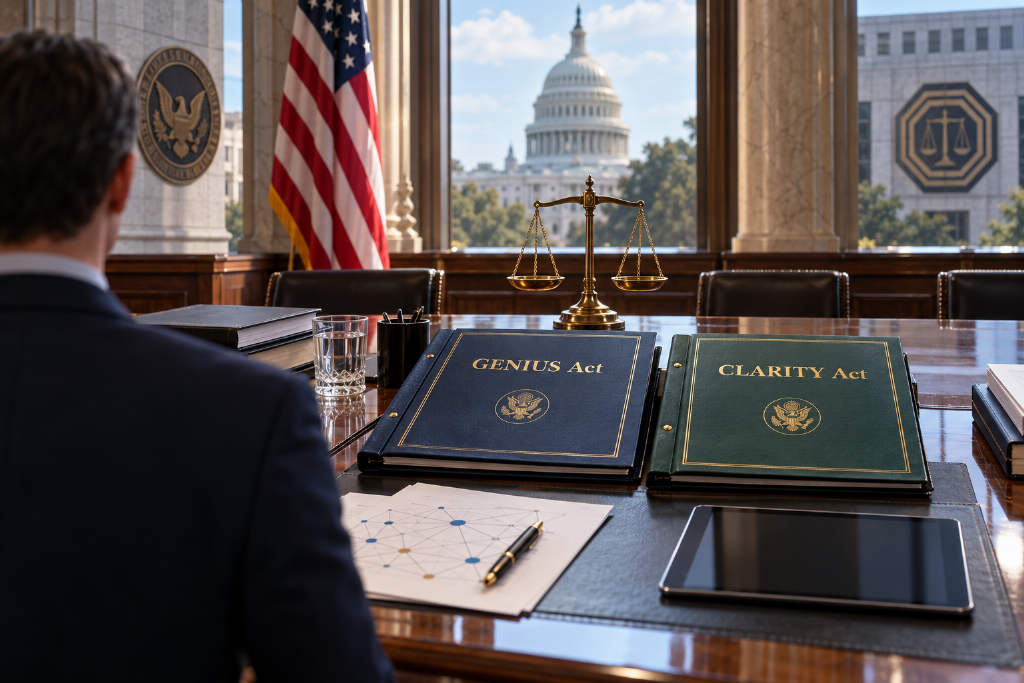
Tom Emmer says GENIUS Act needs the CLARITY Act framework

U.S. House Majority Whip Tom Emmer said the GENIUS Act needs the regulatory framework laid out in the CLARITY Act. He said crypto legislation needs clear rules so innovation and investor protection can be balanced rather than treated as competing goals. According to Emmer, the CLARITY Act is designed to define how jurisdiction over digital assets is split between the U.S. Securities and Exchange Commission and the Commodity Futures Trading Commission. The GENIUS Act, by contrast, is focused on promoting the research and application of blockchain technology. Emmer said the two bills should work together to give the industry a more complete legal foundation.

190
Tom Emmer says GENIUS Act needs the CLARITY Act framework
Brazil
3 days agoNews Editor

Itaú files for crypto provider status as Brazil’s licensing window tightens

Itaú Unibanco, Brazil’s largest private bank, has formally registered its role as a cryptocurrency service provider with the Central Bank of Brazil, according to local reports cited by Bitcoin Magazine. The filing covers crypto intermediation and custody, placing the bank inside the country’s new licensing regime for virtual asset service providers. The move comes as Brazil compresses the timeline for firms already operating in crypto to seek authorization. Under resolutions 519, 520, and 521, published in 2025 and early 2026, the central bank created a new category called Sociedades Prestadoras de Serviços de Ativos Virtuais, or SPSAVs. The rules took effect on Feb. 2, 2026, and classify providers as intermediaries, custodians, or brokers. For customers, the custody piece is central: regulated providers must segregate client assets from company funds, meet minimum capital thresholds, and comply with governance and anti-money laundering standards similar to those applied to securities brokers. The framework also brought crypto transactions into Brazil’s foreign-exchange regime, including a $100,000 cap on transfers involving unauthorized counterparties. Tighter standards approved on July 1, 2026 will start in 2027, while smaller Segment 5 institutions are barred from offering virtual asset services.

150
Itaú files for crypto provider status as Brazil’s licensing window tightens
Total 1667 items
Go topage